

Introduction to The FOREVER CAMPAIGN
What form of world have we wrought from the subconscious of our own divinity?


The following is an original interpretation of copyrighted works and well loved modules, mega-dungeons, and settings. Please know that, as with all things, the table is alive and it can take carefully planned intentions and twist them however it wishes. If any of the original lore is wrong, that is by design and not by mistake. I have no doubt the FOREVER CAMPAIGN can become it’s own thing with a few name changes and original drawings. But right now it is not, it is still alive, not a corpse to be ossified and preserved in books.
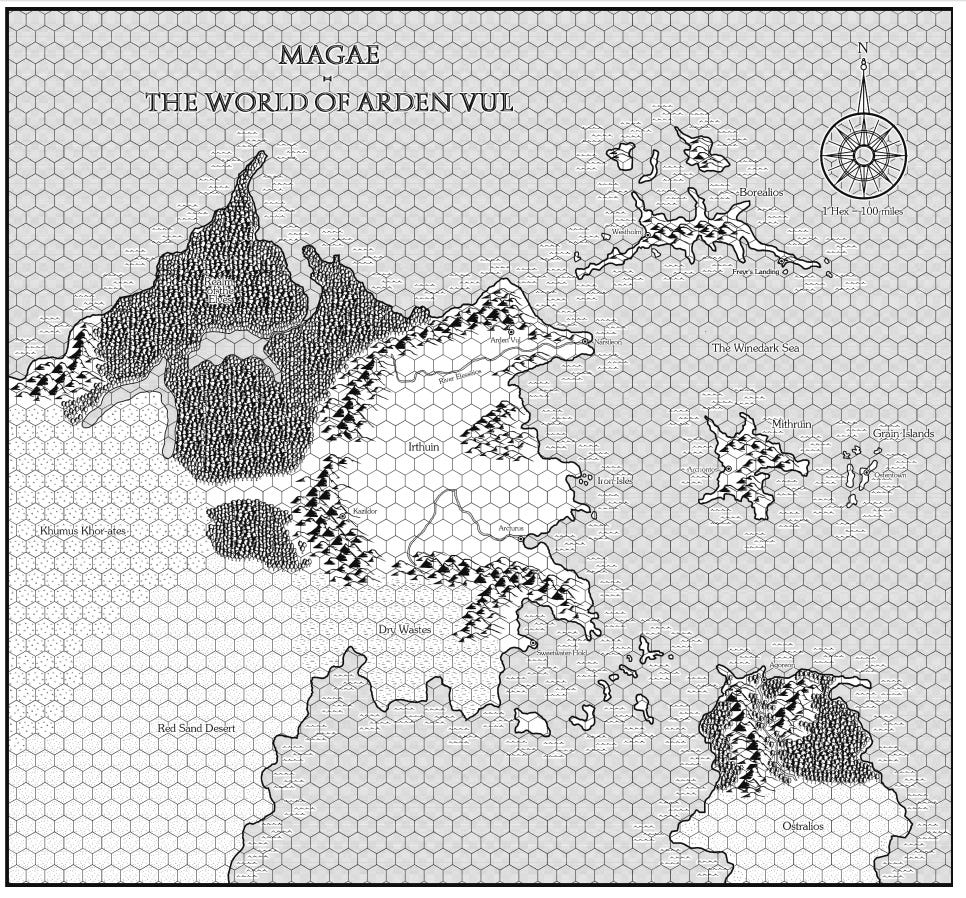
The Planet — Magae
The world in which the FOREVER CAMPAIGN takes place is known as Magae1 . It is an Earth-like planet with much of the world not yet explored. There is a single moon: Luna, which completes a rotation once every 28 days. The Wine-Dark Sea is the ocean that binds together all continents and islands of northern Magae.
The current dominant society in this section of the world is the Archontean Empire. They have effected every section of the world displayed above though a recent civil war has caused a massive retraction of their forces. Much of the knowledge and terms used throughout the FOREVER CAMPAIGN are through the lens of the Archontean Empire2.
The following geographical history will be truncated as much of the surrounding areas are not relevant to the plot at hand.
Mithruin
In the center of the Wine-Dark Sea sits the island of Mithruin3. It’s name means “of mythic divinity”. This is where the Archonteans began and where they spread from. The only city of note is Archontos, the mega-capital city of the entire empire and their emperor: the Archon. Much of Mithruin is home to estates of Archontean nobility, the great imperial silver mines, and millennia of accumulated magical and mundane treasures. While Mithruin is obviously home home to the Archontean people, it is also home to a sizable population of ‘imperial goblins’, now civilized by centuries of enslavement, as well as a small colony of dwarves.
Also known as Archontea4.
Grain Islands
A chain of islands east of Mithruin, perfectly suited for agriculture. Halflings originated here and were the first outsiders to join the Archontean Empire.
Irthuin
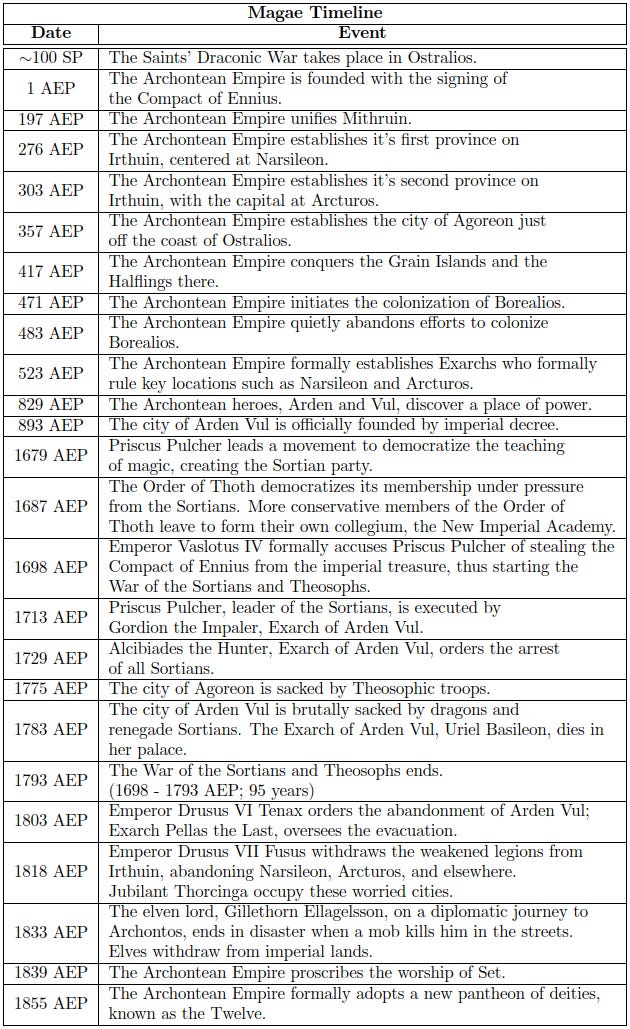
Irthuin5 is a huge continent lying west of Mithruin across the Wine-Dark Sea. It’s name means “not of myth” or “of mundanity”. The eastern coastline had formed numerous provinces of the Archontean Empire in antiquity, before the empire receded during the 95 year War of Sortians and Theosophs, leaving behind the abandoned cities of Narsileon and Arcturos.
The Thorcinga, Khumus, True High Elves, and Mountain Dwarves of Kazildor all reside on Irthuin.
Also known as Occidentos6.
Borealios
The Archontean name for the island chain to the north of the Wine-Dark Sea. Borealios7 is home to the Wiskinga. Although the Archonteans have claimed Borealios as theirs, and the emperor has assigned a general to pacify the region, Archontean authority is limited to a few small towns near Freyr’s Landing.
Borealios is under a constant demonic incursion rushing over the northern mountain ranges. Orcs and their dark masters have destroyed and pillaged hundreds of human settlements and led to the birth of Half-Orcs. These Half-Orcs can pass as human in most cases and have spread beyond Borealios.
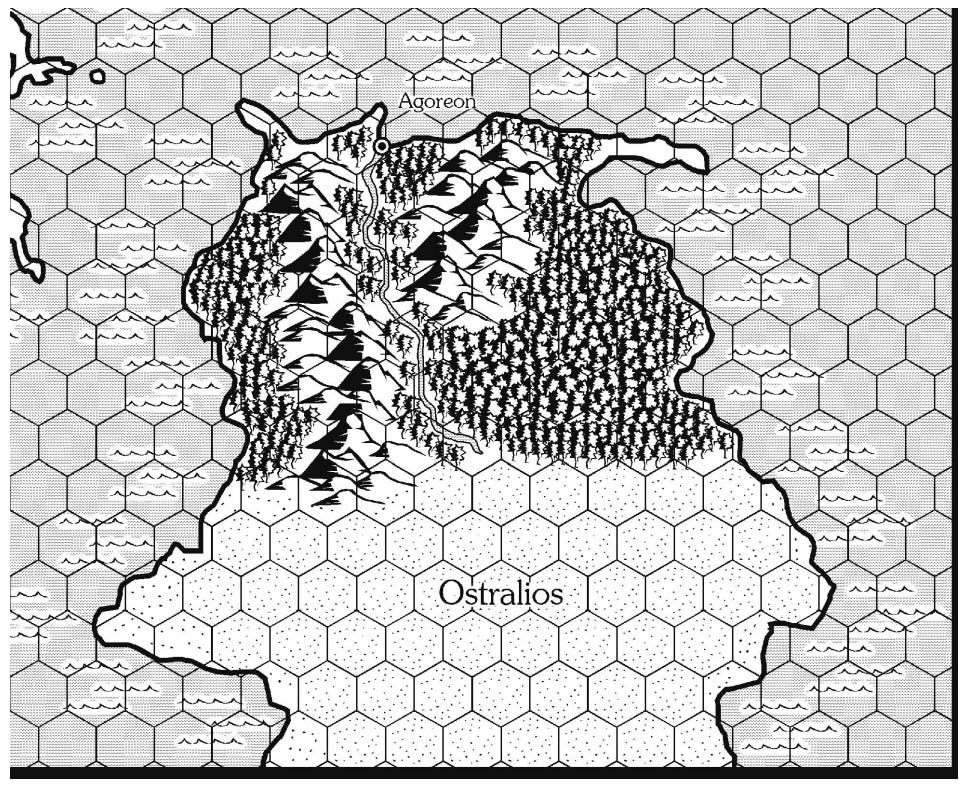
Ostralios
The continent lying to the south of Mithruin across the Wine-Dark Sea. Ostralios8 is the home of Gnomes and the site of a great dragon war known as The Saints’ Draconic War. The northern-most three hundred miles or so of Ostralios are thickly-forested tropical jungle, inhabited by monsters, refugees, and fierce local tribes. It is said the ruins of older empires lie buried in the jungles, as the ruins of the Archontean city of Agoreon still lie unconquered. To the south, beyond the belt of mountains that rim this jungle, are said to lie exotic civilizations of great wealth and power; to the Archonteans, however, these stories are mostly legend.
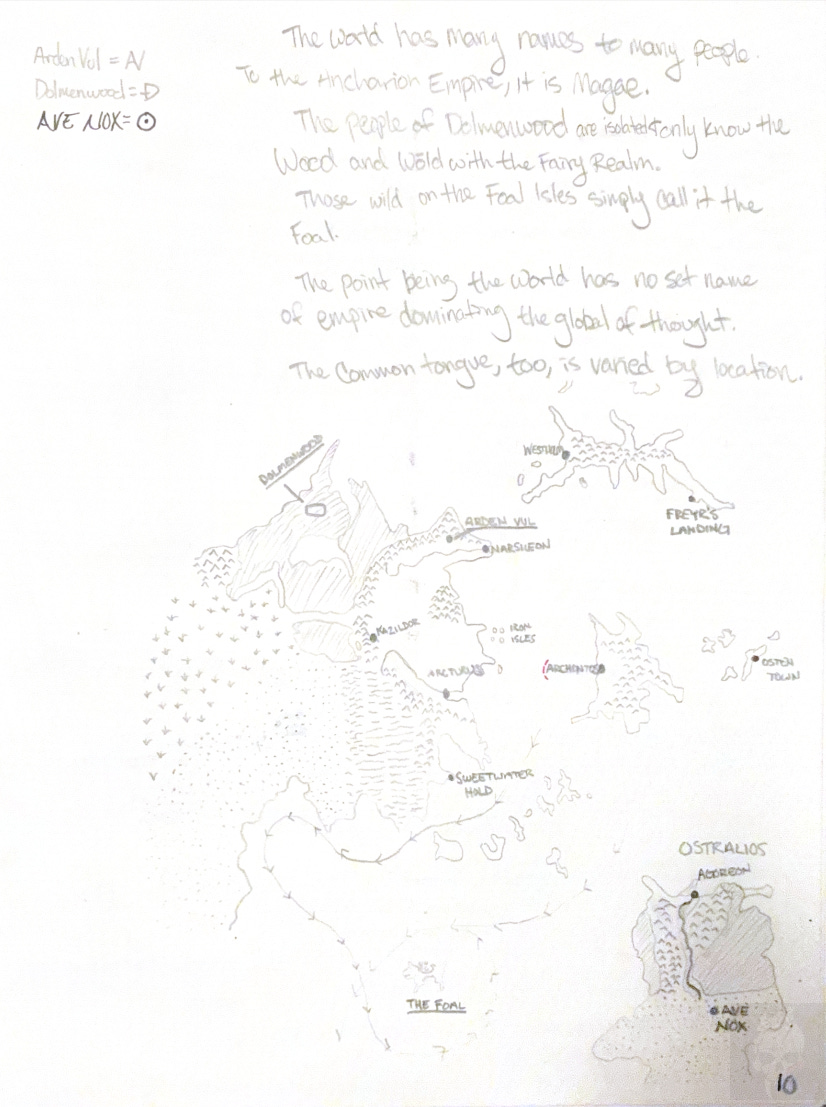
The Culture of Magae — Calendar, Languages, and Deities
Calendar
The dominant calendar used in the eastern portion of Magae is the Ennian calendar, that is, the official Archontean imperial calendar. The founding of the Empire is traditionally dated from the year of the signing of the Compact of Ennius (Ennii pactum). Dates are thus given either as SP, or before the compact (literally sine pacti, ‘without the compact’), or as AEP, or after the compact (literally ab Ennii pacto, ‘from the compact of Ennius’). The calendar is called the Ennian Calendar.
The current year is 1992 AEP9. In official documents, however, it is common to date documents to a specific year of the reign of a given Emperor/Empress; thus, the current year (1992 AEP) might also be presented as “in the first year of Emperor Phocius”. For this reason, lists of emperors with their regnal dates are held in all administrative offices of the empire.
The Thorcinga once had a distinct calendar, but it has been completely overshadowed by the Ennian calendar and is almost entirely forgotten. The Wiskinga never developed a distinct calendar system; in the north, then, years are reckoned by the season and/or by the lifespan of local jarls (although civilized Wiskinga use the Ennian calendar).
The dwarves use an entirely distinct calendrical system, one based on the founding of the great hold of Kazildor, an event that occurred in 1877 SP (by Ennian reckoning); the dwarves date years ‘from the stone, and thus the present is the year 3869 ‘from
the stone’. Elves use a calendar based on years from the creation of Gildorin, the first elf; according to this reckoning, it is the year 8,532. Halflings and imperial goblins follow the Ennian calendar.
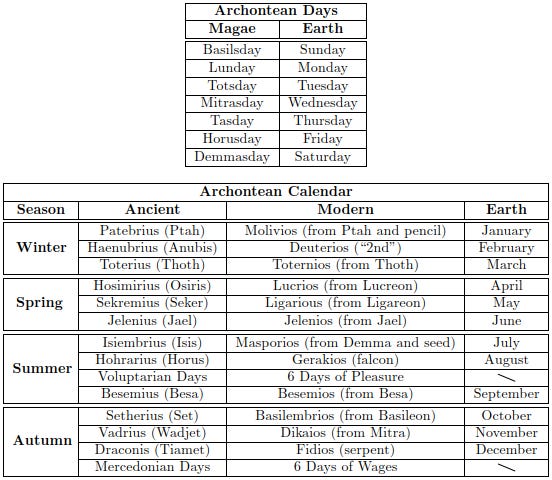
Days, Weeks, Months
Years on Magae are comprised of 372 days. The Archonteans, and most other human civilizations, divide this period into twelve months of 30 days based on the lunar cycle.10 Two six-day intercalary periods are added to the year, one in the late summer (harvest festival) and one in the winter (the winter solstice).
Weeks are seven days long. The Archontean names for the days of the week are: Basilsday, Lunday, Totsday, Mitrasday, Tasday, Horasday, and Demmasday (these are named after, respectively, the basileus, the moon, Thoth, Mitra, Ptah, Horus, and Demma).
Languages
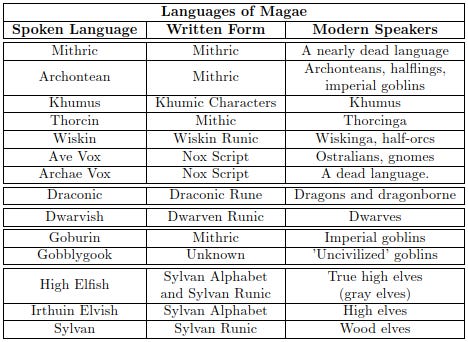
Language is a picture into a culture. It is something organic and wild that only recently in human history have we attempted to tame it and control it. In a world where nations do not exist and empires are crumbling, it makes sense that a Common tongue should not fully exist and a traveling group would need to learn many different languages to be effective during said travel.
Know yee that the exploration of language is not an endevor of the Archonteans who wish to iron out the folds11 that make us different but rather myself, the author of the FOREVER CAMPAIGN. If I go on a tangent here, it is because I fell into a rabbit hole.
Mithric — The Language of Magic and Arcana
Mithric is a dead language. It is still employed as the language of arcane theory and practice, so all magic users trained at one of the imperial collegia have some knowledge of Mithric.
Mithric was the original writing system of the Archontean Empire. In expressing the spoken form of Mithric, the early Archonteans employed a set of angular letters (30) alongside a relatively small corpus of symbols (50); the symbols were mostly those used for public expressions of power and might. In the decline of the empire, spoken Mithric has largely fallen out of vogue, having been replaced by its linguistic daughter, Archontean.
Archontean — The “Common” Tongue or Lingua Franca
While Archontean uses the same Mithric alphabet, four letters and all the symbols have largely fallen away; this means that modern written Archontean uses only twenty-six letters of the old Mithric alphabet. As citizens of the empire, both the halflings of the Grain Islands and the imperial goblins speak Archontean like their masters and use the exact same version of Mithric for writing. The Thorcinga adopted the Mithric alphabet to their own distinct spoken language; in so doing, they retained two of the now-lost original Mithric letters and have added three others (for a total of 31 letters).
Ave Vox — The Native Language of Ostralios
A Mithric adjacent language akin to how Greek (Vox Script) is to Latin (Mithric). It has a rare cognate here or there with Mithric but just as English stole Latin from the Romans, there is not enough in common to gain a pidgin or mutual understanding.
Archae Vox — The Ancient Tongue of a Lost Civilization
Archae Vox12 is more akin to how Greek (Ave Vox) is to Byzantine Greek (Archae Vox). There is some mutual understanding but archaic phrases or references are commonly lost in translation.
Dwarven — The Rigid Endeavor to preserve the core of a language at all costs
The Dwarvish language is a touchstone, a solid rock of comfort, it is supposed to be something immutable and inalienable. However as more and more vaults become increasing isolated by witholding whatever secrets they’ve unearthed, and by unwilling to request outside assistence, the Dwarven Language is very slowly mutating. Sometimes a chronicler will go to spend time at a vault and audit the language but it takes centuries for that kind of resource to become available.
High Elfish, Irthuin Elvish, or Sylvan — Lost Immortality and the New Sin
In the distant past the elves contented themselves with a set of 275 runes (known as Sylvan Runic) that were used primarily for aesthetic and simple descriptive purposes (e.g., in smithing). Their system was adopted and modified by the intelligent Fae. While the elves eventually adopted a true alphabet (see below), they still employ Sylvan Runic for artistic, decorative, and symbolic purposes.
In response to the growth of human culture and writing, the elven lords commissioned a true alphabet to complement Sylvan Runic. This system (known as Sylvan Alphabet), begun 3,500 years ago, was intended to represent spoken Elvish in both aesthetic and functional ways. Sylvan appears as a cursive, semi-continuous script of 31 letters, in which new thoughts are represented by elaborate geometric patterns which themselves carry hints of meaning (that is, each symbol, including symbols denoting pauses, connotes a different intention, emotion, or expectation).
Goburin and Gobblygook — The Taint of Civilization
Goburin is a pidgin between Archontean and Gobblygook. Gobblygook is thought to be unintelligible noises like what animals make.
Draconic — Raw Power and Awe
To those who do not speak it, Draconic is a single language written using Draconic Runes. Scholars who have studied Draconic but never spoke or used it have created an alphabet of sorts to mimic the Draconic Runes (like the Korean language), but this is actually a dead end.
To those who do speak and use Draconic, the actual name of the language is Glav (to speak or converse) and is written using Iokharic. There are several dialects to Glav which vary between species, environment, and culture; meaning that Draconic is more of a Common/pidgin equivalent or basis for other dialects to branch from.
Khumus / Thorcin / Wiskin — World at Large
Khumic developed without any influence from Mithric. It contains 19 letters and 200+ symbols, all of which are typically joined together in an elegant, cursive hand.
The Thorcinga adopted the Mithric alphabet to their own distinct spoken language; in so doing, they retained two of the now-lost original Mithric letters and have added three others (for a total of 31 letters).
Wiskin Runic is a simple runic system modeled on Dwarven Runic. It is able to convey numbers from 1-10 and in groups of 10, 50, and 100. It also includes a set of 200 or so angular runes used to describe concepts, temperatures, time, and nouns.
The Timeline — History Marches on FOREVER
The Great Pantheon
There were twelve original gods of Archontos, with the earliest written reference to one of them dating to 1218 SP (it refers to Thoth). Certainly, all of the Twelve were acknowledged by c.500 SP, and thus they were the gods whom the Archonteans brought with them in the great period of imperial expansion. During this golden age, the Twelve each boasted broad portfolios of ‘expertise’. This made syncretism not only possible but common during the Archontean expansion: it was easy enough for the Archonteans to see in some foreign god a particular ‘aspect’ of one of the Twelve.
Many aspects were thus ‘discovered. For instance, Sekhmet (F) came to be understood as an aspect of Wadjet, with special influence on fire and warfare. Of course, whether or not such foreign ‘gods’ were distinct entities or merely aspects of the Twelve was, of course, a hotly debated theological point. Some modern theologians blame this flexible and accepting approach for the gradual decline of the Twelve; these critics suggest that by claiming to encompass all things, the Twelve lost their uniqueness and thus their appeal to the broader populace. For whatever reason, worship of the Twelve had become ossified and ritualized by the time of the War of Sortians and Theosophs.
By 1855 AEP, the imperial government decided to officially link itself to a new slate of deities, ones whose divine support promised to revive the empire. The new pantheon centered around ten very powerful deities (“the Ten”) who were served by seventeen (or more) lesser gods. Theological cynics could and did note that many of these ‘new’ gods resembled the most popular of the ‘aspects’ of the old pantheon, but the official position is that the Ten are distinct from the Twelve.13
For the past 400 years, the emperor has also been the subject of a cult; the theology of this is a bit fuzzy, and ‘worship’ of the emperor is primarily understood as a measure of loyalty more than anything else.
The Ostralian Pantheon
Ostralios’s critical religious event is known as The Saints’ Draconic War, which occurred over 2,000 years ago. While many different versions of the events are told, the following are the core facts:
Falazure’s expansion and cruelty caused mortals to begin rebelling.
Tiamat took this as a right to make examples.
Bahamut began conscription to oppose Tiamat.
Four heroes approached Aasterinian outside Io’s Temple to entreat Io but was denied.
Simeon played a battle of wits with Aasterinian while the others ransacked the temple.
Taking an artifact from Io’s Temple, Cuthbert approached Astilabor for the right to create a horde.
Astilabor said if Cuthbert could beat her in battle, it would be considered.
Using the artifact from the temple, Cuthbert bested Astilabor who then denied him.
Cuthbert slays Astilabor and claims her horde as his own.
Lendys recognizes Cuthbert and agrees Falazure, Tiamat, and Bahamut have gone too far.
The heroes with Lendys route both Tiamat and Bahamut.
Both Tiamat and Bahamut entreat Chronepsis for help and all three disappear.
Garyx begins to raze the lower half of Ostralios (rendering it into a desert).
Hlal intercepts Garyx and both perish fighting.
The heroes lay a trap for the fleeing Falazure and end him.
Tamara negotiates peace and withdrawal of dragonkind from Ostralios.
St Cuthbert
A man who became a paladin after a close friend was taken as a slave by Falazure.
St Pontoise
A woman who worked as a battlefield nurse and was found by Cuthbert.
St Simeon
A bard who heard Cuthbert and Pontoise were creating a counter army and knew of an artifact in Io’s Temple.
St Ulrich
One of Bahamut’s military generals who was the sole survivor of a skirmish. Joined Cuthbert immediately upon hearing of his uprising.
The Lost Saint
No one knows who the Lost Saint is. It could be a hero who died fighting Falazure, a fallen soldier during the fight, or an innocent killed in the beginning.
Aasterinian
Messenger for Io and trickster deity. Apparently easy to distract. Often mocks or taunts very lawful creatures into folly.
Astilabor
Astilabor represents the desire in all dragons to acquire wealth and power. However, she dislikes greed. She cannot abide thievery unless such an act is done in the name of building one’s hoard.
Bahamut
Bahamut, the Platinum Dragon, is the King of the Good Dragons, and a child of Io. He is also referred to as the God of Dragons or the Lord of the North Wind. Bahamut is depicted as a massive dragon with platinum scales and blue eyes.
Chronepsis
The draconic god of fate, death, and judgement. Has infinite hourglasses counting down the life of all dragons, mortals, and deities. Chronepsis knows the future and fate of all from creation to the end of time. He is silent, unconcerned, dispassionate, and a watcher. No one directly worships Chronepsis but pay respect to him.
Falazure
The terrifying Night Dragon who enslaves mortals to becoming mindless juju zombies. Falazure is wretched, crawling thing who is terrifyingly beautiful with skeletal wings. Falazure is not able to fly.
Garyx
Cleansers of worlds, represents sheer power and destructive force of dragonkind. Razed half of Ostralios.
Hlal
Hlal is a sleek, copper colored dragon with a ready grin and a happy glint in her eye. Of the dragon gods, she is the most friendly to non-dragons. Hlal enjoys sharing stories and songs with those who appreciate such things, regardless of the listener’s race or background. She has little use for tyrants, and even less patience for cruelty or bullying. She teaches that one must be free of restraint, whether real or psychological, in order to freely express one’s opinions.
Io
Io is the chief deity worshipped by dragons, god of dragonkind, balance, and peace. Io is unfathomably large; it is said the largest dragon who ever lived is smaller than a single one of his scales, which are blue, gold, brass, or red, and edged with silver and dark purple. He can, and does, appear as any age or breed of dragon, however. Io is revered by dragons as the creator of the multiverse and of their race. He is also worshiped by some half-dragons, kobolds, lizardfolk, troglodytes, and even some humans.
Io never engaged with mortals directly on Ostralios but worship was forced by both Bahamut and Tiamat.
Lendys
Lendys is the dragon god of balance and justice. Unlike Chronepsis, who judges dragons after they die, Lendys metes out justice during a dragon’s life.
Tamara
Tamara is the dragon goddess of life, light, and mercy. Tamara is the kindest and most benevolent of the draconic deities. Some mistake this quality for weakness, but such beings never make this mistake twice.
Tiamat
An avaricious, supremely vain, and self-proclaimed creator of all evil dragonkind. She enjoys destroying treasure, torture, and one-sided combat (murder). She is a five-headed dragon with each one being a different color: red, white, green, blue, and black.
Bahamut and Tiamat
One myth reveals an unusual reason for the enmity between Bahamut and Tiamat14. Long, long ago, Io created his first children, intent on perfecting all aspects of dragons. His first child was a striking creation, full of all the perfect, physical characteristics of dragonkind. Io named it Vorel, which means “beautiful” in Draconic. As it happened, Vorel had very limited intellect and discernment. Vorel was sweet-natured, bright-eyed, and eager to please, much as a friendly dog is with its master. Though it was flawed, Io still loved this little dragon.
Io found that one form was too limited to contain everything he wanted to include. So he made two—one male and one female, one good and one evil. Embodied in them were the passions and propensities of all dragons.
These offspring were Bahamut and Tiamat. Io intended for the two wyrmlings to grow up together, learn from each other, and eventually mate, bringing together all the attributes of dragonkind. The children of Tiamat and Bahamut would be wonderful, perfect dragons.
Instead of filial love and affection, immediate rivalry sprang up between the two. Their natures were too much at odds to allow them to feel affection or even respect for one another. Both of them sought Io’s approbation and competed for his favor.
Bahamut strove to gain his father’s good regard through exemplary behavior, trying to be the noblest creature he could be. Tiamat, on the other hand, used cunning and caprice. After several schemes failed to raise her above her brother in their father’s affections, Tiamat designed a dramatic plot.
The wyrmling goddess endeavored to sow jealousy and enmity between Bahamut and Vorel. She had Vorel destroy some of Bahamut’s favorite magic devices. Although Bahamut merely reacted with regret at the loss of his treasures, Tiamat told their father that her brother had been enraged by the destruction. Then she waited until a time when all others in the household slept the deep sleep of dragonkind. She slew Vorel, Io’s first creation, and spattered some of her victim’s blood on Bahamut.
Tiamat knew that Io loved Vorel and anticipated that Bahamut would be slain or at least exiled for his apparent murder of the firstborn—but she erred. She supposed that Io would react as she would to such an incident. The Creator of Dragonkind, however, did not respond with the shortsighted rage and impetuousness Tiamat expected. Instead, his love for his children led him to investigate and ascertain the truth. Grievously disappointed, he banished Tiamat from his presence. He still cared for and loved his daughter but could not continue to foster her in his household.
With this rejection, Tiamat’s love for her father turned to hate. She then decided to bring forth creatures of her own and became the Creator of Evil Dragonkind. Bahamut felt driven to oppose his sister’s evil and became the King of the Good Dragons.
In this way, Io lost three children—one to death, one to evil, and one to good. Some say that he still hopes to create a perfect race of dragons through the offspring of Bahamut and Tiamat. The Great Eternal Wheel turns, and Io is patient.
The Races — Finally Some Good Fucking Food
The following is only the people the party have met and interacted with. There are lots more but this is getting too long for Substack.
Humans — The Fleas
Humans are one of the youngest races on Magae. While the elder races hid away in forests and mountains, remaining elusive and exclusionary, humans spread. Their ingenuity and drive were novel to the world and, despite their relatively short-lived lives, a concept of legacy and heritage enabled generations to build villages, towns, and cities. Their fecundity and adaptability also allowed humans to fill many niche roles no matter what environment they spread to. This includes when exposed to the elder races, with many humans finding ways to enable trade and diplomacy.
The greatest challenge to humans and what they construct is their relative instability due to their short lives and tendency to swing for extremes, whether that extreme is complete dedication to a profession or craft, or an ideology. This leads to human lands being in a constant state of flux, new ideas arising and disappearing within centuries, and racial relations drifting between bigotry and acceptance. The elder races often find themselves outpaced by the constantly fluctuating human civilization but once an elder race discovers or perfects something, it becomes doctrine for human society.
Humans often find themselves becoming adventurers for any number of reasons. It can be wanderlust, ambition, or simple happenstance.
Archonteans
Properly the term refers to the humans from the great city of Archontos, capital of the empire and dominant center on the island of Mithruin, but it has come to refer to any citizen of the empire, regardless of where he/she resides.
Archonteans are typically medium height (5’4” to 5’7”), with black or dark brown hair and slightly olive-colored skin. They are naturally arrogant when dealing with ‘barbarians’, even while deferring to the myriad social hierarchies that govern Archontean society. Archontean society is highly ordered, with a strong belief in the ‘city’ as the natural building block of civilization.
While Archonteans do farm, the elites typically run their plantations from the nearest ‘civilized’ location. As a result of their urban focus, the Archonteans have been great builders, of towns and cities, bridges, aqueducts, roads, and fortifications.
Ostralians
These peoples claim a heritage over 3,000 years old and started out as dragon worshipers until the Draconic Wars 2,000 years ago. At that time, five heroes slew the more evil draconic rulers. The remaining dragons swiftly withdraw, leaving the cultures they helped stabilize and govern on their own. This led to power vacuums forming and civil war. Then the Archonteans landed and easily subdued the warring native populace.
The Archontean Empire first set foot on Ostralios in 357 AEP and established Agoreon. However, due to the War of the Sortians and Theosophs in 1775 AEP, in the Archontean Empire abandoned their Ostalios colony of Agoreon after 1400 years. This all occurred outside living memory but those that were left behind and the natives of Ostralios live on. Some still worship the dragons while others worship the heroes that vanquished them. Others still worship the gods brought over by the Archontean Empire.
Zaharans
The road to power requires sacrifice. For some, it was blind faith in a higher power. For the Zaharans15, it was crafting dark pacts with careless powers beyond the blackness of space. Gods, in a sense, yes. But these powers have no interest in man as a race or society. These powers are strictly interested in the use of mens’ souls for their own practice before returning the remains to the wheel. Zaharans used to span all of Magae until their hubris led to their terrible downfall over 2,000 years ago. Whatever great cataclysm that befell them is lost to pre-history as most of their knowledge and society are nothing but ruins or dust.
However that does not mean there are no Zaharan anymore. While their lineage may not be as evident to the eye, the dark pacts they made have polluted the stuff that made their soul, leading to odd children being born. These children still carry some of that forbidden lore within them, find themselves drawn to places of unknown power, hear the whispers of things not there and yet so very real. Those who manage to suppress (or at least hide) their fey urges to kill or consume sapient flesh grow into warped and unstable humans capable of some of the most horrid abominations without second thought.
Some say that actual Zaharans still exist, that their bloodline is strong in the forgotten corners of the world; that they hide, biding their time until they can rebuild their empires anew. Some do not dare utter the word Zaharan for fear one of their demons will come and rip the very words from their throat. Only in hushed or careless tones does one even mention this cursed bloodline’s name.
While their nature of individuals whom society has rejected leads to a majority of Zaharans to be Chaotic, a scant few turn away that darkness and strive to better the world they were born into. Those who find they cannot suffer to live on either path choose self-exile, to not be tempted by the darkness they carry nor feel the shame it brings.
While blasphemous to even talk about, it is estimated that only about 1 in 100 million born carry the taint of Zahar. Those who survive to adulthood and produce children have a 25% chance of producing a Zaharan child. And if two Zaharans have a child, it is 100% chance the child will be of Zahar.
As the bloodline begins to recongeal, certain traits become more noticeable. Tall statures with slender builds, long of limb and slim of fingers, oval- or diamond-shaped faces with near-pointed slanted ears, prominent cheekbones with narrow jaws and full lips. Noses are straight, long, and rooted high near the brow with large, almond-shaped eyes colored between black, amber, or hazel. Hair is almost always black or bluish black in color with thin, dark eyebrows.
Zaharians speak Archae Vox.
Dwarves
Dwarves appear cold, distant, and avaricious to humans. By nature, they are clannish, wary of outsiders, and extremely vengeful, to the extent that they frequently seem xenophobic. Sarcastic jokes about ‘the generosity of dwarves’ are common in Archontos. Dwarves are reputed to be masters of stonecarving, metalworking and enchantment; still, as a rule they refuse to offer their goods for sale, so few are able to evaluate these claims. In keeping with their flinty, avaricious natures, dwarven nobles are often teetotalers, as they fear that the effects of alcohol may render them open to being tricked or cheated. They prefer dour black clothes, sometimes embroidered with silver or gold thread. A majority of dwarves, especially warrior clans, favor beards, but most dwarven craftsmen do not due to the danger it presents. The dwarves are locked in a constant shadow war with the doppelgangers, who they believe are infiltrating and replacing those in their society for millennium.
Dwarven society is two-tiered. The upper tier is composed of the established clans, most named after a type of rock or similar substance (e.g. Malachite); members of these clans are the elites, and enjoy special privileges within dwarven holds. It is said that members of a clan will go to any end to rescue a clansman, or at least to recover his/her body and life-stone. The lower tier of dwarven society is composed of the clan-less. Some of the clanless were born that way, others were exiled from their clans for misdeeds, while still others are survivors of clans that imploded or were eliminated in factional politics.
The clanless do much of the mining and shaping, usually under the supervision of a dwarf from an established clan. Those who do not mine, travel and establish outposts, trade routes, and deal with the ‘lesser races’. In truth, the further one goes from the mountain homes, the lower they are in dwarven society. Dwarven names are usually derived from types of rock or stone, and/or stone-related crafting, mining or related skills. Given names vary widely, but clan names (if a dwarf has a clan) are relatively few in number, and are of great antiquity.
When dwarves die, they are said to ‘take to the stone’; whether this is literal or figurative is an open question among human sages, for the dwarves are particularly tight-lipped about such intensely intimate practices.
Inside Dwarven Culture
When a dwarf exclaims an oath, it is no light matter. Dwarven oaths spoken are as concrete as if they written into the crust of the earth itself. If the dwarf who made the oath perishes, then it falls onto their children to carry the burden, and so it continues. Therefore, a dwarf without children would be speaking in vain if they proclaim an oath with other dwarven witnesses.
When a tool fails a dwarf and leads to a disaster, a major investigation is conducted to determine who was at fault: the tool’s maker, the tool user, or the item upon which the tool was employed. If it is found the tool’s crafter is at fault, they must either exile themselves from the vaults or swear an oath to rectify the disaster (which may include replacing a dead dwarf in labor). If it is found the tool user was at fault, a minor funeral is held as no dwarf worth remembering would perish due to reckless use in the line of duty. Finally, if the item is at fault, a new methodology to prevent further mishaps must be created. The use of the word “item” is loose enough to encompass creatures, locations, and even rituals.
Dwarves cannot use arcane magic, being creatures of the earth itself. Only the infertile order of Furnacewives can channel the Maker’s Fire of creation into destruction.
Dwarves are slowly going extinct and the war between Doppelgangers16 and other races vying for underground territory is only exacerbating this. A dwarven woman can only produce four offspring in her life and only 1/3rd are female. Any attempts to increase this pace leads to stillborn children (and there is still a 10% chance of miscarrying after the first birth when observing this slower pace).
Mountain Dwarves
Mountain Dwarves are all clanned. Some specialize in warfare, some in crafting, some in bureaucracy, others in trade; but all carry a life-stone which proves they are of a clan and not a doppelganger in disguise. There are clan-less dwarves in the mountains as well and they do live with elevated privileges than those sent beyond the mountains.
Hill Dwarves
Hill Dwarves are a step removed from the rest of dwarven society. They are keepers of forts, outposts, trade routes, or strategic positions. Often overseen by a clan dwarf, they live militant and rigid lives.
Plains Dwarves
These dwarves are nomads, outcasts, and exiles. A few become tinkerers or merchants but none wish to encounter a clan dwarf. These dwarves are some of the most common seen outside of the mountain homes and have built a majority of the stereotypes other races have crafted. At best, they are victims of a merciless hierarchy; but at worst, they are the dregs of dwarven society, drunks, gamblers, and hired blades.
City Dwarves
There are only two types of city dwarf: a disfavored clan dwarf on diplomatic duty and an outcast so far from home, they have little hope to ever recover their dwarven pride. They have forsaken their heritage for that of another race’s comforts.
Half-Dwarves
A half-dwarf is also known as a Mül. They have no distinguishing features that betray their half-blood heritage except for the lack of culture so blatant on their demeanor. A Mül from a female dwarf looks just like a dwarf and often adopts the visage of a city dwarf to avoid the horrific persecution they would suffer if their parentage was ever found out. A Mül from a female human looks human. All Müls are technically the same race as their birth mother.
Elves
Elves were originally part of an immortal fae society outside of the realm of Magae. However, for one reason or another, they found themselves upon Magae and mortal. Over the last 8,000 years, their culture has fractured with the elves who accepted their mortality being known as High Elves; the elves who replaced their fae worship with nature (the Sylvan) being known as Wood Elves; and the elves who conspire to return to their original realm of the fae being known as the True High Elves.
Elven society is broadly collective, with younger elves associating themselves with seniors who have established reputations for great deeds, excellent craftsmanship, or particular wisdom. Elves prize core balance in all things. Those elves who are able to blend their emotions, magical sensibilities, knowledge, and connections with the Sylvan or Fae are held as paragons. Elves are curious and inquisitive, with most elves pursuing a highly specific intellectual interest, as well as a specific interest in magic of some sort, whether as a practitioner, theorist, or amateur. Elves are particularly attracted by wisdom, by knowledge, by beauty, and by magical lore.
Elves have two names, one given name and one that describes one of their parents. Only the most venerable and powerful of elves dispense with the parental name.
High Elves
High elves are the most abundant of the elves. After losing their immortality, these elves accepted Magae as their home and, while still wary of humans, often find themselves intermingling with them. The assassination of Gillethorn Ellagelsson in 1833 AEP has led to a majority of proper elven society withdrawing away from Archonteans though they still deal with other humans.
True High Elves
True High Elves are rare in the human-dominated areas of Magae. The largest and best-known enclave of true high elves is the realm of Lady Ellagel and Lord Gallador, located deep within the central forests of Irthuin, plotting for a way to regain their lost immortality. Those elves that travel in human society are either high elves or wood elves. True high elves only do so for highly specific, temporary reasons (searching for a specific object or piece of knowledge); on occasion, they reside as advisors in the courts of human lords. Most humans have never seen a true high elf.
Wood Elves
Turning their back upon the fae, the wood elves intend to use the Sylvan to regain their immortality. Choosing the preservation of nature and rejecting the opulence and perceived vanity of their previous elven culture, wood elves strive to integrate with nature. These are the most common types in Ostralios.
Half-Elves
There are always elves who break from the norm and adventure into the unknown, these elves inevitably come into contact with humans and, so distant or personally removed from their origins, fall in love. The spawn of an elf and a human is known as a half-elf. Half-elves are very rare outside of established elf settlements near or within human civilization. Note that there are no elven settlements within Archontean cities since 1833 AEP.
Gnomes
Natives of Ostralios and with limited Archontean contact outside of the invasion leading to the construction of Agoreon, Gnomes frequently work alongside the humans of Ostralios and share the same language. Gnomes are inquisitive. They love to learn by personal experience. At times they’re even reckless. Their curiosity makes them skilled tinkerers, as they are always trying new ways to build things. Gnomes are inveterate explorers, tricksters, and inventors. They have a knack for both illusion and alchemy.
Gnomes tend to live in hilly or wooded lands, almost always in burrows of some sort. Gnome communities are relatively small with burrows typically clustered together within nature. Gnomes who wish for more than a safe home build aboveground and usually near another race’s settlement. These gnomes offer gem cutting, alchemy, or tutoring as services. Gnomes generally wear leather or earth tones, though they decorate their clothes with intricate stitching or fine jewelry.
Halflings
Halflings are uncommon, and largely found in segregated agricultural communities. Most halflings known to the Empire live on the Grain Islands to the east of Archontea, where their agricultural prowess provides important food supplies to Archontos itself.
These halfling communities are largely self-regulating, although they are under the loose supervision of the imperial strategos and his legion. Halflings were thought to live in secluded communities or ‘shires’, however no evidence has been found. Local halfling lore does not fully account for their existence on the Grain Islands, being content to distantly recall the Great Voyage on the Big Ships.
Although most halflings are content with their rural lives, a few bold sorts attach themselves to the staff of the Strategos and end up traveling ‘across the water’ to Archontos. These halflings are seen as exotic and rustic, and they tend to suffer some general paternalistic patronizing from Imperial citizens. Imperial officials treat halflings in a genial but patronizing way, and will assume them to be political naifs. Ordinary citizens of the Empire treat halflings as great curiosities, and will often approach them, pinch them, and ask them simplistic questions.
Half-Orcs
Half-orcs are the offspring of humans and orcs, the latter being demonic shock troops pouring over the Borealios mountains. While orcs remain engaged in a protracted and culturally ingrained conflict against human settlements, half-orcs do not inherently share this aggression or the same ideology of orcs themselves. Although half-orcs do have a hint of their orcish heritage, they appear nearly indistinguishable from humans. Some may have more stooped features or pronounced teeth, a grayish tone to the skin, or strange colored irises.
Half-orcs typically grow up in human settlements if they are not killed and were initially distrusted due to their lineage and the ongoing state of war. However, centuries of conflict have shown half-orcs growing up in human settlements often take up arms against the demons. Despite their demonic orc blood, half-orcs demonstrate a full range of moral behavior and cultural adaptability. Their physical resilience and adaptability make them well-suited for a variety of roles, including honorable service among human clans.
Imperial Goblins
The humans of Archontos enslaved the goblins of Mithruin in antiquity and put them to work as miners and as laborers on the vast imperial latifundia of Mithruin. Millennia of servitude — but also of exposure to the ‘civilizing’ forces of the Archontean empire - have created a distinct racial subgroup. Even if they resemble ‘wild goblins’ (monsters) physically, these ‘imperial goblins are culturally distinct from their monstrous kin and thus look at wild goblins with disdain.
Imperial goblins are short, long-armed, and bandy legged, with yellowish skin and, frequently, yellow eyes. They possess black hair and are comfortable wearing minimal clothing, but possess their own standards for fine dress (these include tall conical caps, colorful vests, and jodhpurs tucked into beautiful leather boots). They reach a maximum of 4’ 8” in height. Goblins are known for their wiry strength and tough constitutions.
Many imperial goblins have been freed from slavery over the years, leading to a large number of imperial freedgoblin citizens. Although these freedgoblins are noted as highly effective merchants, estate managers, and bureaucrats, they are typically treated as second-class citizens by ordinary Archonteans and are the object of casual racism on the part of the Archonteans.
Tieflings
Extraordinarily rare, tieflings are considered twisted, devious, and untrustworthy. Common folk believe tieflings follow an inherent tendency to commit evil due to their strange appearance. Despite this persecution, tieflings have all the same moral tendencies as their human parents. However, tieflings still feel out of place or unnatural, and often must contend with a feeling of otherworldly “wrongness”. In truth, tieflings are the result of a pregnancy carried near an extremely potent source of magic.
Shunned and maligned by the world at large, tieflings maintain a low profile and make their livings as spies, thieves, assassins, or smugglers. Few find the “legitimate” world very appealing or hospitable, and instead are forced into the seedier parts of society.
Tieflings appear human at a glance, although they all possess at least one unnatural feature that reveals their warped heritage. At the least, tieflings have a disturbing demeanor or odd skin color, but most also possess small horns, strange colored eyes, or needle-sharp teeth. In extreme cases, a tiefling may have a barbed tail or cloven feet. No two tieflings have the same appearance.
Tieflings are treated as monsters and universally reviled by members of almost every other race, good or evil. Most are persecuted and cast out from society when discovered. In such cases, the outcast takes to the wild, dons a disguise, or, more commonly, works themself into a position of power and authority so that they can make their own rules. Tieflings find easier acceptance among monstrous races such as orcs, goblins, and gnolls, but only if they prove their own strength and power. As a result of this relentless rejection, tieflings view other races as cruel monsters and reciprocate the cycle of violence.
(MADJ-eye)
This is a view of arrogance and a sense of crumbling conceit can be felt as the Archontean Empire continues to establish itself as the dominant cultures. As the game progresses, it will clash with other cultures and, much like how the real life Koreas vied for dominance when they were first willed into existence by outsiders in the late 1940s, many factions want to devour the Empire in order to leech its notoriety and power.
(MYTH-roon) or (MYTH-roo-in)
(ar-KON-tee-ah). Archon means “ruler” in Greek.
(EER-thoon) or (EER-thoo-in)
(ah-sih-den-tem) or (oss-EE-den-tum). Occidentem means “west” in Latin.
(bor-ee-AL-ee-os) or (bo-REEL-os). Borealis means “north” in Greek.
(aw-STRAL-ee-ehns)
The original timeline starts in 2993 AEP but I felt that made the Empire far too old also thought it shouldn’t take over 1300 years to recover from a civil war. So I just wound the clock back.
Truth is, I’m a big fan of there being thirteen 28 day months. But the Archonteans are the big power these days. Maybe later.
I want to be clear that this is more like Old English than Middle English. "Þæt cild slǣpþ"; "Hwæt mǣnþ þæt?"
Note: the Archonteans remain accepting of foreign gods; it is not at all uncommon to find temples or shrines to the Wiskin and Thorcin pantheons existing alongside those of their Archontean rivals within the communities of the Empire. The same, however, is not true beyond the borders of the empire; shrines and temples to the Ten are unwelcome outside the imperial boundaries.
This Tiamat is a different representation than the one traditionally portrayed in Archontean mythology.
(zah-HARR-ahn)
Yes, there is an ongoing war between dwarves and doppelgangers.